
Finding Baton Rouge Residents
Build a Baton Rouge residents directory search around the fact already known. With an address, classify its city-parish jurisdiction and locate its parcel before searching for names. With a name, add a ZIP, an approximate age, a business tie, or an earlier address. With a historic address, preserve the subdivision, lot, and former street name. This keeps people with common names from being merged and helps distinguish a postal Baton Rouge address from one in Baker, Central, Zachary, or unincorporated East Baton Rouge Parish.
No official roll is a full household census. A deed names parties to a transfer, not every occupant. A tax mailing address may belong to an owner who lives elsewhere. A voter match shows registration, subject to state limits, but does not list every person in a home. Renters and people who do not vote can be absent from these sources. Treat each match as one piece of a larger identity check.
- Confirm the municipality with EBRGIS, then save the parcel lot ID and standardized situs address.
- Check the assessor route for the owner of record and keep the tax mailing address separate from the site address.
- Use the Louisiana voter portal with a name or exact address, adding ZIP and birth month or year when known.
- Follow deeds, court files, probate records, or business filings only when they fit the person and purpose.
- Ask the clerk, library, or archive for records that the public web interfaces do not expose.
Baton Rouge Directory Offices
East Baton Rouge Parish centralizes much of its record trail. The Clerk of Court records conveyances and mortgages, keeps the 19th Judicial District Court files, issues marriage licenses, and maintains an archive. The Assessor holds the ownership and assessment layer. EBRGIS supplies parcel and jurisdiction context, while the Louisiana Secretary of State maintains voter searches. These offices should be read together, not as rival directories. The full address chain belongs in the Baton Rouge street directory walkthrough.
East Baton Rouge Assessor
222 St. Louis Street, Room 126
Baton Rouge, LA 70802
225-389-3920
Check Baton Rouge Jurisdiction
A Baton Rouge postal label does not always mean an address lies inside the city. The EBRGIS jurisdiction lookup classifies an address as Baton Rouge, Baker, Central, Zachary, or unincorporated East Baton Rouge Parish. Enter an address number, a street name, or both. The search accepts wildcards. Numbered streets use forms such as 1ST and 43RD, and SAINT is written out for names such as SAINT LOUIS.
This first check prevents a residents directory search from going to the wrong municipal office. Postal and civic geography can diverge. EBRGIS property data, for example, can pair ZIP 70818 with Central even though broader postal references associate the code with Baton Rouge service. Record the jurisdiction result, postal city, and ZIP as separate facts.
- Parcel
- A mapped tract used for assessment and land records.
- Situs address
- The physical address of the parcel, which may differ from an owner's mailing address.
- Index
- A finding aid that points to a document; it is not always the document image.
- Criss-cross directory
- A printed directory arranged by street and address instead of only by surname.
Baton Rouge Property Clues
The parish uses two distinct property routes. The Assessor's SmartCAMA service is advertised as the assessment search, although its stable public fields were not visible during research. EBRGIS Property Lookup is a separate, free parish-wide address index. It accepts address, subdivision, business name, NAICS code, or lot ID. Its detail report can be printed or saved as CSV and may show ZIP, zoning, precinct, council district, school district, subdivision, neighborhood, and land-use fields.
The Assessor property interface is the ownership starting point shown below.
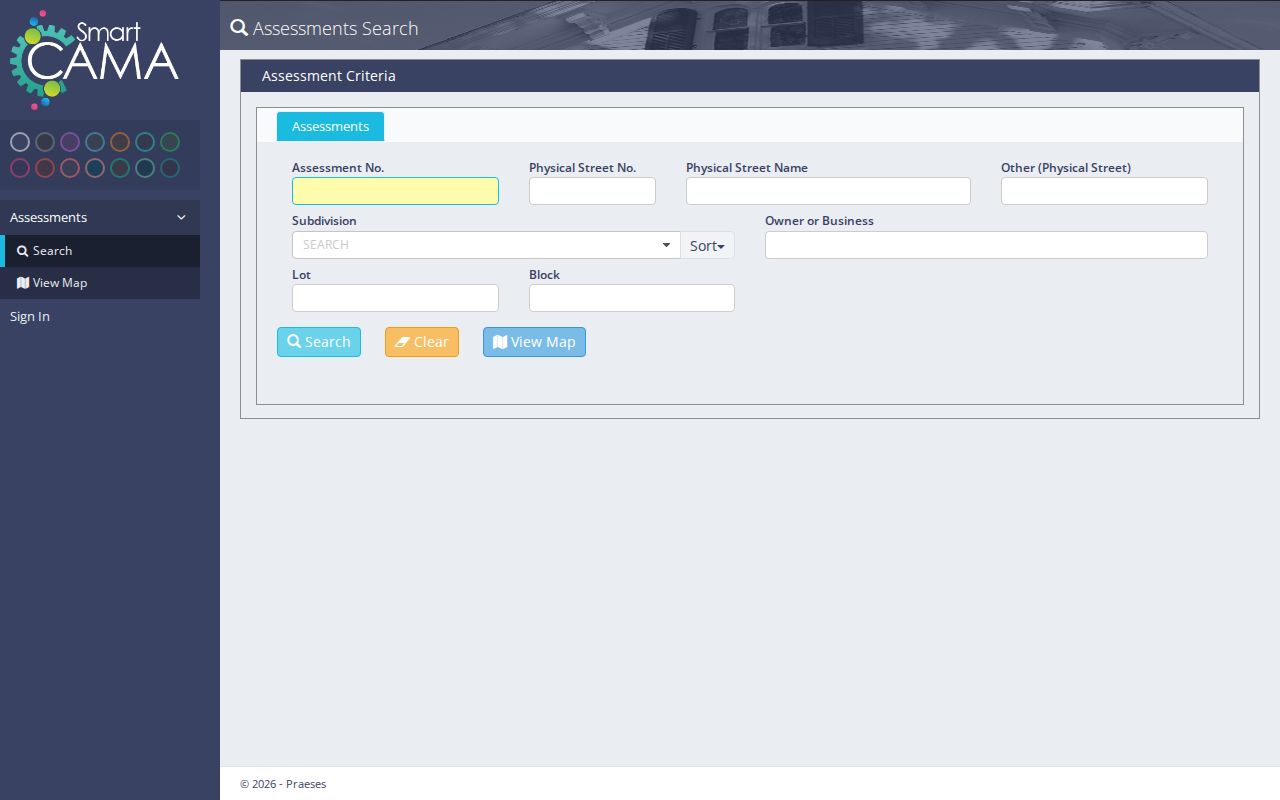
The captured interface confirms the official route, but a researcher should not claim unseen owner fields. If the browser view fails, call the Assessor or visit its downtown, Coursey, or Central office. Ask for the current tax card and keep the owner, situs address, and tax mailing address in separate notes.
Confirm Baton Rouge Voter Records
The Louisiana voter portal offers name, address, and parish paths. Its name form uses first name, last name, ZIP code, birth month, and birth year. The address form uses ZIP, street address, apartment or lot, and city. A narrow match can support identity and address research, but it is registration evidence rather than proof of every person who lives at a property. Louisiana R.S. 18:154 also limits voter-record handling, and protected voters or Address Confidentiality Program participants may not expose a residential address.
| Field | Use in a Baton Rouge search |
|---|---|
| First and last name | Required identity terms on the name route |
| ZIP code | Narrows common names without proving city limits |
| Birth month and year | Separates people who share a name |
| Address and apt/lot | Checks registration tied to one exact location |
The official voter name form shows those identity fields.
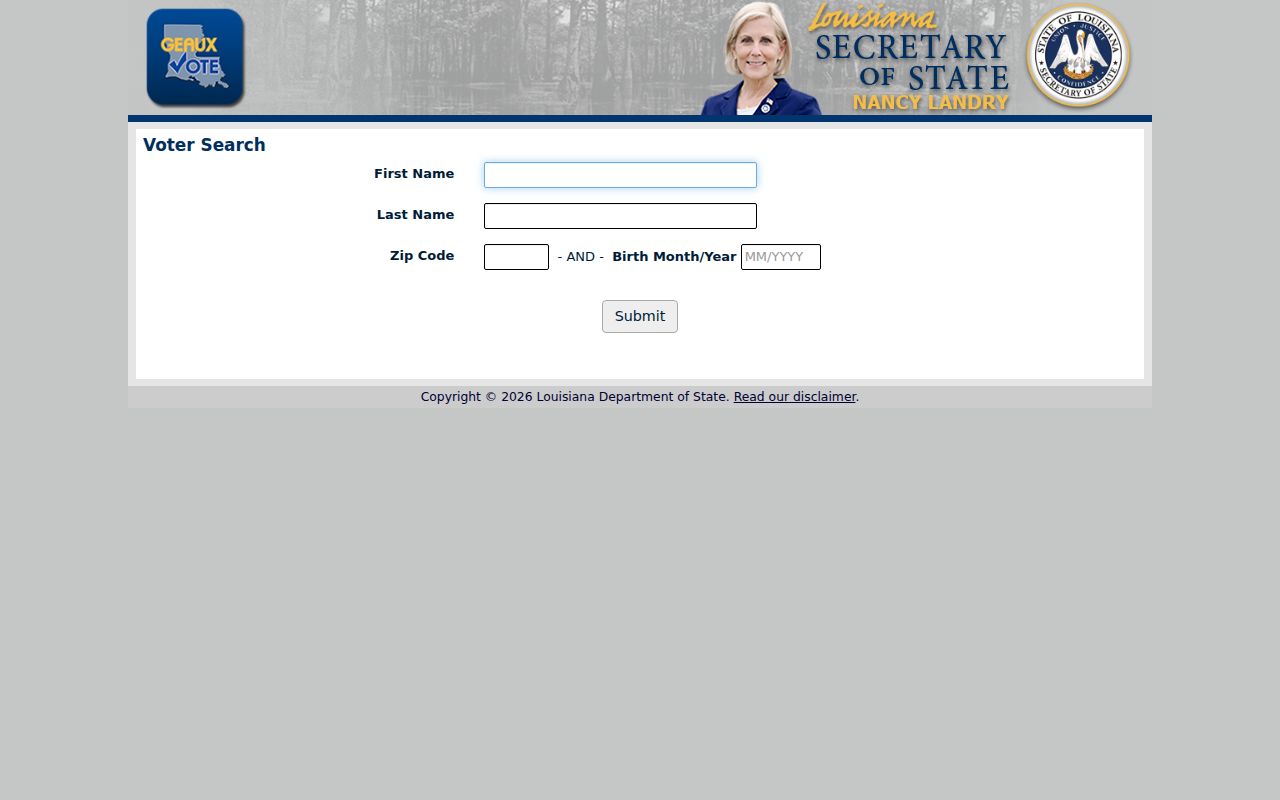
Use the added date and ZIP fields to reduce false matches. Do not infer party choice, household membership, or present occupancy from a registration result.
Current Baton Rouge Directory Sources
A current Baton Rouge residents directory must be assembled from records with different scopes. Property tools focus on land and owners. The voter portal focuses on registration. Clerk indexes identify parties to filed instruments or cases. Civic association records describe groups, not private member households. A business or professional license can establish an affiliation, yet it does not establish where that person lives.
| Source | Who It Lists | Keeper | Access |
|---|---|---|---|
| Assessment and parcel records | Owners and mapped parcels | Parish Assessor and EBRGIS | Public web routes and office help |
| Voter Portal | Registered voters | Louisiana Secretary of State | Public forms with legal limits |
| Clerk indexes | Deed, mortgage, court, and probate parties | East Baton Rouge Clerk | Subscription online; free counter inspection |
| Commercial Search | Entities, officers, and agents | Louisiana Secretary of State | Free public search |
| Neighborhood Registry | Registered civic groups | City-Parish | Public registry and map |
Choose the roll by the claim being tested. Ownership calls for the assessor and deed chain. A named person's current public trail may call for voter, court, probate, business, or license evidence. A Baton Rouge resident lookup works best with the full two-source verification method. Official sources expose narrower facts than commercial tools, but they identify the keeper, record type, and correction route.
ClerkConnect Access in Baton Rouge
ClerkConnect routes land, civil, and criminal inquiries for East Baton Rouge Parish, but the public landing screens expose a subscription boundary rather than open search rows. The contrast matters: the Clerk's public notice permits free inspection during regular office hours, while ordinary copies generally cost $1 per page and certification has a separate fee. Older files may also be split among the courthouse, City Hall, and Archives according to case-number ranges.
The ClerkConnect property inquiry is shown at its login boundary.
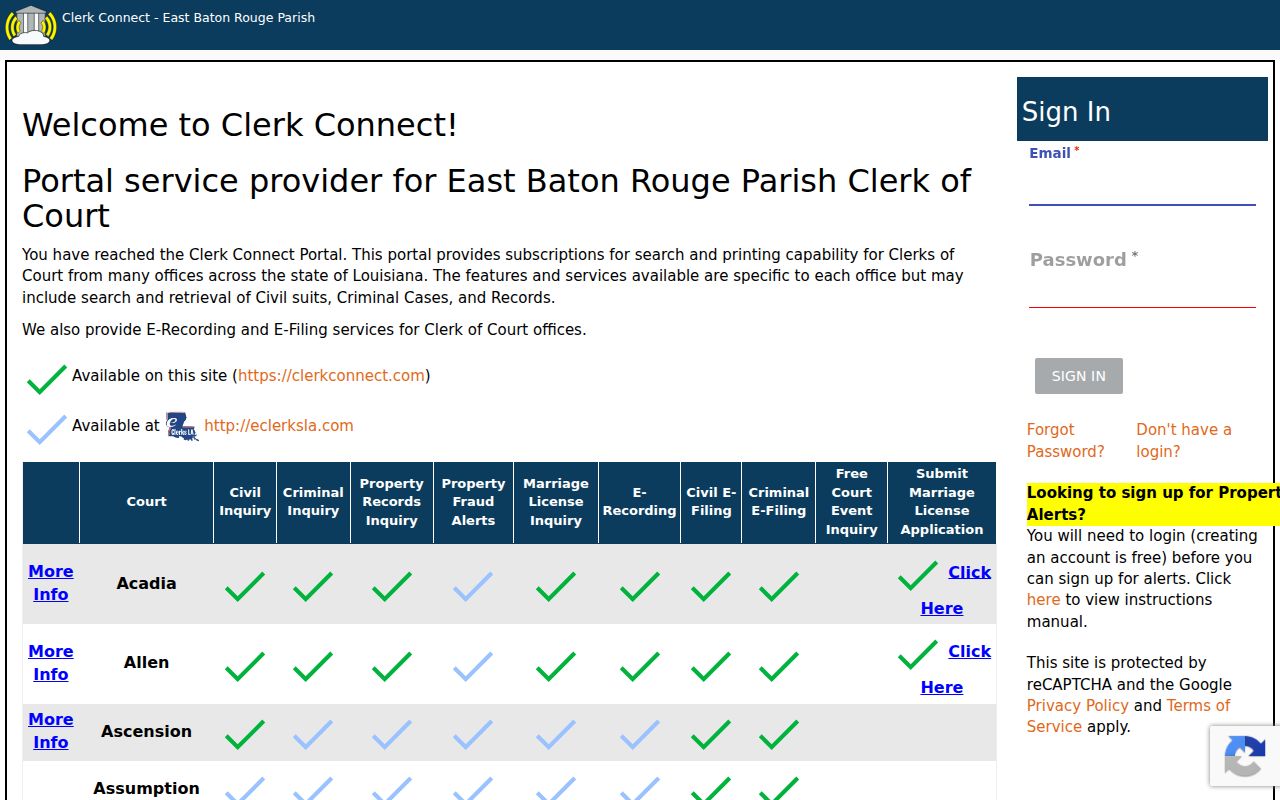
A failed login is not the end of the record trail. Take the party name, date range, record type, and preferred format to the Recording Department or email the Clerk's records custodian. For old material, the Archives Department holds original parish records from 1782, tax rolls through 1872, notarial bundles, and historic court files.
Baton Rouge Court Name Trails
The East Baton Rouge Parish Clerk serves the 19th Judicial District Court and Family Court. A civil name hit can point to pleadings, petitions, answers, motions, judgments, or probate filings. It should not be treated as proof that every named party lives in Baton Rouge. Read the case type, filing date, party role, docket number, and disposition. Then compare the name with an independent address, parcel, obituary, or business record.
The civil inquiry portal also displays the subscription state.
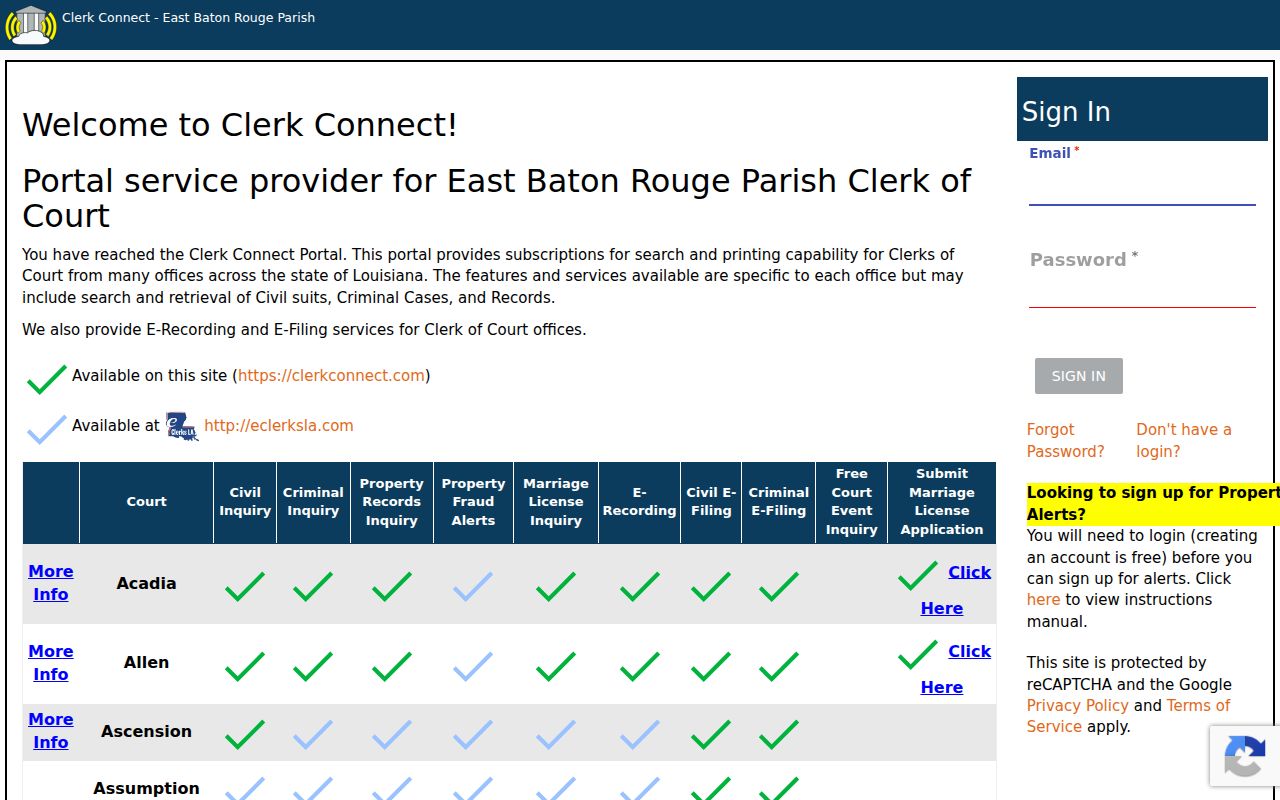
When the online screen stops, public viewers may inspect many files at Clerk facilities. Electronic filing began in 2018, and the civil department became paperless in 2020 except for probate and specified original documents. Older case-number blocks remain in City Hall or Archives, so give staff both the number and record class.
Vital Records Have Closed Doors
Louisiana birth records remain confidential for 100 years after the birth year, and death records for 50 years after the death year. Eligible relatives and authorized people can request certified copies through Louisiana Department of Health channels. Requests may go by mail, in person, or through the state's approved online, phone, or fax vendor. The East Baton Rouge Clerk offers local walk-in birth and recent death certificates at Downtown City Hall, but its death service reaches only June 2012 forward.
Marriage licenses come through the Clerk's Public Service Department, while divorce copies come from the clerk in the parish where the divorce occurred. Closed-record law is not overridden by the Louisiana Public Records Law. A residents directory lead from an obituary or directory may help identify the right event, but it does not create eligibility for a certificate.
Lawful use. Use Baton Rouge records for personal research, family history, estate work, civic review, or scam checks. Never use an address to stalk, threaten, or harass anyone.
Business Links, Not Home Proof
The Louisiana Secretary of State Commercial Search can connect a person to an entity as an officer or registered agent. Search modes cover entity name, charter number, trade registration, name reservation, and officer or agent. Partial-name searching and spelling variants help with uncertain names. Louisiana's state license directory then routes to the relevant board for a credential check. Each board sets its own fields and status terms.
These are useful cross-checks in a Baton Rouge residents directory when the same name appears more than once. They establish an organization or license link, not a present home address. Save the entity number, filing name, role, and board result, then compare them with a dated independent record. For an unclaimed-property lead, the Treasury search accepts a name or business name plus city and ZIP, with a separate claim-status route.
Historical Baton Rouge Directories
The Baton Rouge Room and Genealogy Collection occupy the second floor of the Main Library at Goodwood. Their local sources include directories, maps, newspapers, yearbooks, photographs, manuscripts, family histories, and obituary indexes. Public obituary runs are labeled by decade from the 1940s through the 1970s and then 1979 through 1991. Some databases need a library card or an in-library computer, so call the Baton Rouge Room at 225-231-3752 or Genealogy at 225-231-3751 before a long visit.
LSU finding aids verify Baton Rouge directory references for 1856, 1895, 1899, 1905, and 1906. Those years do not prove a complete run or publisher history. A dated entry may show a name, address, phone number, occupation, spouse notation, or business tie. Reverse or criss-cross editions turn an address into an occupant lead. The Baton Rouge city directory page explains the shelf, citation method, and census pairing without treating a printed entry as present-day proof.
Note: Search both old and current street names when a Baton Rouge address appears in the city's dated 1942 street-name-change file.
Request Missing Baton Rouge Records
Not every Baton Rouge record is online. Louisiana Public Records Law, La. R.S. 44:1 et seq., gives adults a route to inspect or copy public records, subject to specific exemptions. R.S. 44:31 addresses the right of access, R.S. 44:32 covers custodian duties and copy procedures, and R.S. 44:35 provides remedies for a denial or delay. The Clerk accepts public inspection during regular hours and identifies a records custodian for requests.
A useful request names the record series, person or property, date range, case or instrument number if known, and desired format. Ask for an estimate before ordering a large file. If the office says the record is in active use or stored elsewhere, ask when it will be available and which building holds it. For archival or directory material, contact the library or Louisiana State Archives instead of sending a broad request to the Clerk.
Match the request channel to the keeper. Recording staff can work from an ORIGINAL AND BUNDLE number, a party name, or the Vendee/Vendor index used for conveyances. Civil staff need a case number when possible because older civil, family, and probate ranges are stored in different buildings. Archives staff can search original parish records and notarial bundles when a modern portal has no published cutoff. Library staff are the better choice for a city directory edition, obituary index, newspaper, yearbook, or Sanborn map. Give them the name, address, and likely year, then ask whether the item is online, on microfilm, or available only in the reading room.
Official rolls cost more effort than a broad commercial search, yet their limits are clearer. They show the named custodian, the date and type of record, and a way to request a copy or correction. Commercial results may blend stale addresses and same-name people. Confirm every key fact at its source before relying on it.